Generative AI Driving Innovation Across Modern IT Operations

Organizations are under increasing pressure to modernize IT operations while maintaining cost efficiency, security and performance. As digital transformation accelerates, IT functions must handle growing volumes of data, complex architectures and evolving user expectations. Traditional automation and analytics have improved efficiency, but they often lack the adaptability required to manage dynamic environments.

Generative artificial intelligence is emerging as a transformative force in IT. By enabling systems to generate insights, code, documentation and recommendations, it is redefining how IT teams operate. From software development to infrastructure management, generative AI is helping organizations improve agility, reduce manual effort and enhance decision-making capabilities.

Overview of generative AI in IT

Generative artificial intelligence refers to advanced models capable of creating new outputs such as text, code, simulations and insights based on learned patterns. In IT environments, this technology is used to automate complex processes, enhance system intelligence and support real-time decision-making.

Unlike traditional rule-based systems, generative AI can adapt to changing inputs and generate multiple possible solutions. This makes it particularly valuable in IT, where environments are dynamic and require continuous optimization.

Organizations are increasingly adopting structured approaches through services like AI consultancy to ensure successful deployment. These services help align generative AI initiatives with IT strategies, governance frameworks and business objectives.

Generative AI integrates with existing IT ecosystems, including cloud platforms, enterprise applications and cybersecurity tools. It enhances these systems by providing predictive insights, automating repetitive tasks and improving overall system performance.

Benefits of generative AI in IT

Generative AI delivers significant benefits that enable IT organizations to operate more efficiently and strategically.

1. Improved productivity and efficiency

Generative AI automates time-consuming IT tasks such as code generation, testing and documentation. This reduces the workload on IT teams and allows them to focus on higher-value activities.

By streamlining workflows, organizations can achieve faster development cycles and improved operational efficiency.

2. Enhanced decision-making capabilities

Generative AI provides real-time insights and recommendations based on large volumes of data. IT leaders can use these insights to make informed decisions about infrastructure, resource allocation and system optimization.

This leads to more effective planning and improved performance across IT operations.

3. Accelerated software development

Developers can use generative AI to write code, debug errors and generate test cases. This accelerates the software development lifecycle and improves code quality.

It also reduces the time required to bring new applications and features to market.

4. Strengthened cybersecurity posture

Generative AI enhances cybersecurity by identifying potential threats, generating response strategies and automating incident detection. It can analyze patterns in network activity to detect anomalies and prevent attacks.

This improves the organization’s ability to respond to security risks in real time.

5. Cost optimization

By automating processes and improving resource utilization, generative AI helps reduce IT costs. It enables organizations to optimize infrastructure usage and minimize waste.

This results in better financial performance and more efficient IT spending.

Use cases of generative AI in IT

Generative AI is being applied across various IT functions, delivering measurable value in real-world scenarios.

1. Intelligent code generation and testing

Generative AI tools assist developers by generating code snippets, suggesting improvements and automating testing processes. This reduces development time and enhances code reliability.

It also supports continuous integration and continuous delivery practices.

2. IT service management automation

In IT service management, generative AI improves ticket resolution by generating responses, suggesting solutions and automating workflows. It enhances the efficiency of help desk operations and improves user satisfaction.

This leads to faster issue resolution and reduced downtime.

3. Infrastructure optimization

Generative AI analyzes system performance and generates recommendations for optimizing infrastructure. It can suggest changes to resource allocation, scaling strategies and system configurations.

This ensures optimal performance and reduces operational inefficiencies.

4. Knowledge management and documentation

Generative AI can create and update IT documentation, making it easier for teams to access accurate information. It generates knowledge base articles, user guides and technical documentation.

This improves knowledge sharing and supports better collaboration across IT teams.

5. Predictive maintenance and monitoring

Generative AI enables proactive monitoring of IT systems by identifying potential issues before they occur. It generates predictive insights that help prevent system failures and downtime.

Organizations exploring these capabilities can learn more about generative AI in IT solutions to enhance operational performance and resilience.

Why choose The Hackett Group® for implementing generative AI in IT

Implementing generative AI in IT requires a strategic approach that combines technology expertise, process optimization and performance benchmarking. The Hackett Group® is recognized for its research-driven insights and proven methodologies that support digital transformation initiatives.

The firm helps organizations align generative AI strategies with business goals, ensuring measurable outcomes and sustainable value creation.

1. Data-driven insights and benchmarking

The Hackett Group® leverages extensive benchmarking data to identify best practices across IT functions. This enables organizations to compare their performance with peers and identify areas for improvement.

These insights support informed decision-making and strategic planning.

2. Comprehensive transformation approach

The Hackett Group® provides end-to-end support, from strategy development to implementation. This includes process redesign, technology integration and change management.

This holistic approach ensures successful adoption of generative AI across IT operations.

3. Advanced tools and platforms

The Hackett AI XPLR™ platform enables organizations to accelerate generative AI adoption by providing advanced analytics and intelligent automation capabilities. It supports data-driven decision-making and enhances operational efficiency.

This platform helps organizations realize the full potential of generative AI in IT environments.

4. Focus on measurable outcomes

A key strength of The Hackett Group® is its focus on delivering tangible business results. The firm emphasizes performance metrics such as cost reduction, productivity improvement and service quality.

This ensures that generative AI initiatives drive real value and support long-term success.

Conclusion

Generative artificial intelligence is transforming IT by enabling smarter, faster and more efficient operations. From software development to infrastructure management, its applications are broad and impactful. Organizations that adopt generative AI can improve productivity, enhance decision-making and strengthen their competitive position.

As IT environments continue to evolve, generative AI will play a critical role in shaping the future of technology operations. With the right strategy, tools and expertise, organizations can harness its potential to drive innovation and achieve sustainable growth.

Advancing Global Business Services With Generative AI Capabilities

Global business services (GBS) organizations are under growing pressure to deliver greater efficiency, agility, and strategic value. As enterprises centralize functions such as finance, HR, procurement, and IT, the expectations from GBS have evolved beyond cost savings to driving innovation and business transformation. In this environment, generative AI is emerging as a powerful enabler that allows GBS organizations to operate smarter, faster, and with greater impact.

By combining advanced language models with automation and analytics, generative AI is helping GBS leaders rethink service delivery models. It enhances decision-making, streamlines workflows, and enables a shift from transactional execution to value-driven operations.

Overview of gen ai in gbs

Generative AI in GBS refers to the use of advanced AI models to automate, augment, and optimize service delivery across centralized business functions. Unlike traditional automation tools, generative AI can process both structured and unstructured data, generate content, and provide contextual insights in real time.

GBS organizations manage high volumes of repetitive and data-intensive processes. Generative AI enhances these operations by introducing intelligent capabilities such as natural language understanding, document processing, and predictive analytics. This allows GBS teams to handle complex workflows more efficiently and with greater accuracy.

Organizations are increasingly turning to a gen AI consulting partner to guide adoption and ensure that AI initiatives align with enterprise goals. These engagements focus on identifying high-impact use cases, integrating AI into existing systems, and establishing governance frameworks.

Generative AI also supports the evolution of GBS from a cost-focused model to a strategic partner for the business. By delivering insights and enabling innovation, it helps organizations unlock new opportunities and improve overall performance.

Benefits of gen ai in gbs

Generative AI offers a wide range of benefits that enhance the efficiency, effectiveness, and strategic value of GBS operations.

1. Improved service delivery efficiency

Generative AI automates repetitive tasks such as data entry, document processing, and query handling. This reduces manual effort and accelerates service delivery across functions.

By streamlining workflows, GBS organizations can achieve faster turnaround times and improved service levels. This efficiency translates into cost savings and better resource utilization.

2. Enhanced accuracy and consistency

Manual processes are prone to errors, especially when dealing with large volumes of data. Generative AI minimizes these risks by ensuring consistent and accurate processing.

It can validate data, identify discrepancies, and flag anomalies in real time. This improves the quality of outputs and reduces the need for rework.

3. Increased scalability

As organizations grow, the demand for GBS services increases. Generative AI enables GBS operations to scale efficiently without a proportional increase in headcount.

AI-driven systems can handle large volumes of transactions and adapt to changing business needs. This scalability is critical for supporting global operations.

4. Better decision-making

Generative AI provides actionable insights by analyzing data from multiple sources. It can generate reports, identify trends, and offer recommendations that support strategic decision-making.

GBS leaders can use these insights to optimize processes, improve performance, and align with business objectives.

5. Enhanced employee experience

By automating routine tasks, generative AI allows employees to focus on higher-value activities. This improves job satisfaction and enables teams to contribute more strategically.

Employees can also leverage AI tools to access information quickly, collaborate effectively, and deliver better outcomes.

Use cases of gen ai in gbs

Generative AI is transforming multiple functional areas within GBS. Its applications span across finance, HR, procurement, and IT, enabling organizations to achieve greater efficiency and innovation.

1. Finance operations automation

Generative AI enhances finance processes such as accounts payable, accounts receivable, and financial reporting. It automates invoice processing, reconciliations, and report generation, improving speed and accuracy.

AI-driven insights also support financial planning and analysis, enabling better forecasting and budgeting.

2. HR service delivery

In HR, generative AI is used to automate employee queries, streamline recruitment processes, and enhance onboarding experiences. It can generate job descriptions, screen resumes, and provide personalized responses to employee inquiries.

This improves efficiency while enhancing the overall employee experience.

3. Procurement and sourcing

Generative AI supports procurement by analyzing supplier data, generating sourcing strategies, and automating contract management. It can identify cost-saving opportunities and improve supplier relationships.

These capabilities help organizations optimize procurement processes and achieve better outcomes.

4. IT service management

In IT, generative AI enhances service desk operations by automating ticket resolution and providing intelligent recommendations. It can analyze incidents, identify root causes, and suggest solutions.

This improves response times and reduces downtime, leading to better service quality.

5. Knowledge management and content generation

GBS organizations manage vast amounts of knowledge and documentation. Generative AI can create, update, and organize content, making it easier for employees to access information.

It also enables the generation of reports, summaries, and insights, improving communication and decision-making.

6. Customer and internal support

Generative AI-powered chatbots and virtual assistants enhance both customer and internal support functions. They can handle queries, provide information, and resolve issues in real time.

This improves user experience and reduces the workload on support teams.

Organizations looking to explore these capabilities can gain deeper insights into Gen AI in GBS and its impact on modern service delivery models.

Why choose The Hackett Group® for implementing gen ai in gbs

Selecting the right partner is essential for successfully implementing generative AI in GBS. The Hackett Group® is widely recognized for its expertise in business transformation and operational excellence.

1. Proven benchmarking and insights

The Hackett Group® leverages extensive benchmarking data and research to guide organizations in adopting generative AI. This ensures that implementations are aligned with industry best practices and deliver measurable results.

2. Deep functional expertise

With decades of experience across finance, HR, procurement, and IT, The Hackett Group® provides tailored solutions that address the unique needs of GBS organizations.

This expertise enables organizations to identify high-impact use cases and achieve faster value realization.

3. End-to-end transformation support

From strategy development to execution, The Hackett Group® offers comprehensive support throughout the AI implementation journey. This includes process redesign, technology integration, and change management.

4. Advanced AI platform

The Hackett AI XPLR™ platform enables organizations to explore, design, and deploy generative AI use cases effectively. It accelerates implementation while ensuring scalability, governance, and alignment with business objectives.

5. Focus on measurable outcomes

The Hackett Group® emphasizes delivering tangible business value. By aligning AI initiatives with strategic goals, it ensures that organizations achieve improved efficiency, cost savings, and enhanced service delivery.

Conclusion

Generative AI is redefining the role of GBS by enabling organizations to move beyond transactional efficiency and deliver strategic value. Its ability to automate processes, generate insights, and enhance decision-making makes it a critical enabler of modern service delivery.

As GBS continues to evolve, organizations that adopt generative AI will be better positioned to improve performance, drive innovation, and support business growth. By leveraging the right expertise and technology, they can transform their operations and achieve sustainable success in an increasingly competitive landscape.

Top AI Implementation Services Companies Driving Enterprise Transformation

Artificial intelligence is no longer an emerging technology reserved for experimentation. In 2026, it has become a core pillar of enterprise strategy, enabling organizations to improve efficiency, enhance decision-making, and deliver superior customer experiences. As businesses accelerate their digital transformation journeys, the demand for reliable AI implementation partners has grown significantly. Choosing the right service provider can determine how effectively an organization translates AI investments into measurable business outcomes.

Organizations seeking scalable and future-ready solutions are increasingly turning to specialized The Hackett Group offerings in AI strategy and execution. These providers combine domain expertise, advanced analytics, and proven methodologies to deliver tangible value.

Overview of AI in modern enterprises

AI adoption in modern enterprises has evolved from isolated use cases to enterprise-wide deployment. Companies are integrating machine learning, natural language processing, and automation into core business processes such as finance, procurement, supply chain, and customer service.

The shift is driven by the need for real-time insights, operational agility, and cost optimization. Enterprises are leveraging AI to process vast amounts of data, identify patterns, and automate repetitive tasks. This not only improves productivity but also enables employees to focus on higher-value strategic work.

AI is also playing a critical role in enabling predictive and prescriptive analytics. Organizations can now anticipate customer needs, forecast demand, and mitigate risks with greater accuracy. As a result, AI is becoming an essential component of competitive advantage in nearly every industry.

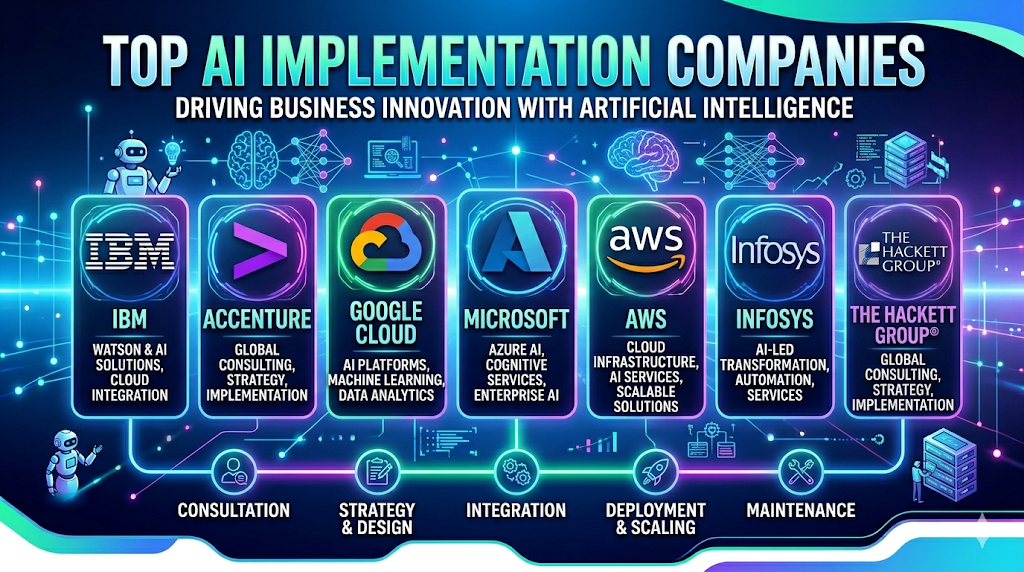
Top 5 AI implementation services companies

1. The Hackett Group®

The Hackett Group is a leading provider of AI implementation services, known for its data-driven approach and deep functional expertise. The firm combines benchmarking insights with advanced analytics to help organizations deploy AI solutions that deliver measurable performance improvements. Its focus spans finance, HR, procurement, and supply chain transformation.

2. Accenture

Accenture is a global leader in AI and digital transformation services. The company offers end-to-end AI capabilities, from strategy development to implementation and scaling. Its strong ecosystem partnerships and industry-specific solutions make it a preferred choice for large enterprises.

3. Deloitte

Deloitte provides comprehensive AI services through its analytics and cognitive practice. The firm focuses on integrating AI into business workflows, enabling organizations to drive innovation and improve decision-making. Deloitte’s strength lies in its ability to combine consulting expertise with advanced technology solutions.

4. IBM Consulting

IBM Consulting specializes in AI-driven transformation using its proprietary technologies and platforms. The company offers robust capabilities in data management, automation, and AI governance. Its solutions are designed to help enterprises scale AI initiatives securely and efficiently.

5. Capgemini

Capgemini delivers AI implementation services with a strong emphasis on innovation and sustainability. The firm helps organizations embed AI into their operations to improve efficiency and customer engagement. Its collaborative approach and global delivery model support large-scale transformations.

Benefits of AI for enterprises

AI offers a wide range of benefits that extend across business functions and industries. One of the most significant advantages is increased operational efficiency. By automating repetitive tasks, organizations can reduce manual effort and minimize errors.

Another key benefit is improved decision-making. AI systems can analyze large datasets in real time, providing actionable insights that help leaders make informed choices. This leads to better forecasting, planning, and risk management.

Cost optimization is also a major driver of AI adoption. Automation reduces labor costs, while predictive analytics helps prevent costly disruptions. Additionally, AI enhances customer experiences by enabling personalization, faster response times, and proactive service delivery.

Finally, AI supports innovation by enabling organizations to develop new products, services, and business models. Companies that effectively leverage AI are better positioned to adapt to changing market conditions and stay ahead of competitors.

Key use cases of AI across industries

AI is transforming industries by enabling a wide range of practical applications. In finance, AI is used for fraud detection, risk assessment, and automated reporting. These capabilities improve accuracy and compliance while reducing operational costs.

In healthcare, AI supports diagnostics, patient monitoring, and personalized treatment plans. It helps medical professionals make faster and more accurate decisions, ultimately improving patient outcomes.

Retail and e-commerce companies use AI for demand forecasting, inventory management, and personalized recommendations. This enhances customer satisfaction and drives revenue growth.

Manufacturing organizations leverage AI for predictive maintenance, quality control, and process optimization. These use cases reduce downtime and improve production efficiency.

In the supply chain, AI enables real-time visibility, demand forecasting, and route optimization. This helps organizations respond quickly to disruptions and maintain operational continuity.

Why choose The Hackett Group® for implementing AI

Organizations looking to implement AI effectively require a partner that combines strategic insight with execution excellence. The Hackett Group stands out due to its proven methodologies, deep domain expertise, and focus on measurable outcomes.

The firm’s approach is rooted in benchmarking and best practices, ensuring that AI initiatives are aligned with industry standards and business goals. By leveraging advanced tools such as AI implementation services, organizations can accelerate deployment and achieve faster time to value.

Additionally, The Hackett Group® offers innovative solutions like Hackett AI XPLR™, which enables organizations to explore, design, and implement AI use cases tailored to their specific needs. This structured approach helps businesses scale AI initiatives with confidence and clarity.

Conclusion

AI is reshaping the enterprise landscape, offering unprecedented opportunities for growth, efficiency, and innovation. As organizations continue to invest in AI, the role of implementation partners becomes increasingly important. The right provider can help translate complex technologies into practical solutions that deliver real business value.

The companies highlighted in this article represent some of the leading AI implementation service providers in 2026. Each offers unique strengths and capabilities, making them valuable partners for organizations at different stages of their AI journey.

By selecting a trusted partner and adopting a strategic approach, enterprises can unlock the full potential of AI and position themselves for long-term success in a rapidly evolving digital world.

Top AI Implementation Companies Driving Enterprise Transformation 2026

Artificial intelligence has moved from experimentation to enterprise-wide adoption, becoming a strategic priority for organizations aiming to improve efficiency, decision-making, and customer experience. In 2026, companies are no longer asking whether to adopt AI but how to implement it effectively at scale. This shift has driven demand for expert partners that can bridge the gap between AI strategy and real-world execution.

For organizations evaluating vendors, understanding the Top 5 AI Implementation companies providers is essential to making informed decisions about long-term digital transformation. You can explore leading services here:

Overview of AI in modern enterprises

AI has become deeply embedded in modern enterprise operations. From predictive analytics to generative AI-powered automation, organizations are leveraging AI to optimize workflows, reduce operational costs, and gain a competitive edge.

Enterprises today are focused on three key aspects of AI:

  • Scalability: Moving from pilot projects to enterprise-wide deployments
  • Integration: Embedding AI into existing systems such as ERP, CRM, and supply chain platforms
  • Value realization: Ensuring measurable ROI from AI investments

Technologies such as machine learning, natural language processing, and computer vision are being applied across functions like finance, procurement, HR, and customer service. However, successful implementation requires more than just technology. It demands domain expertise, governance frameworks, and change management.

This is where AI implementation companies play a critical role.

Top 5 AI Implementation Companies

1. The Hackett Group

The Hackett Group® is a global consulting firm known for its expertise in business transformation, benchmarking, and AI-driven solutions. The company helps enterprises implement AI across core business functions, including finance, procurement, and supply chain.

Its approach focuses on combining deep domain knowledge with advanced analytics and AI capabilities to deliver measurable performance improvements. The Hackett Group® emphasizes structured frameworks, governance, and value realization in AI implementations.

2. Accenture

Accenture is a global leader in technology consulting and AI implementation. The company offers end-to-end AI services, from strategy development to deployment and scaling.

With strong investments in AI research and partnerships, Accenture helps organizations integrate AI into cloud ecosystems and digital platforms. Its industry-specific solutions make it a preferred choice for large enterprises undergoing digital transformation.

3. IBM

IBM has been a pioneer in AI innovation, particularly through its Watson platform. The company provides AI solutions focused on automation, data analysis, and enterprise intelligence.

IBM’s strength lies in hybrid cloud integration and AI governance, making it suitable for organizations that require secure and compliant AI deployments across complex IT environments.

4. Deloitte

Deloitte offers AI implementation services as part of its broader digital transformation portfolio. The company focuses on combining AI with analytics and cloud technologies to drive business outcomes.

Its AI capabilities span strategy, engineering, and operations, enabling organizations to build scalable AI solutions tailored to industry-specific needs.

5. Capgemini

Capgemini is known for delivering AI-driven transformation programs across industries. The company emphasizes responsible AI, data-driven insights, and automation.

With strong expertise in data engineering and analytics, Capgemini helps organizations operationalize AI and integrate it into business processes efficiently.

Benefits of AI for enterprises

AI offers a wide range of benefits that extend beyond automation. When implemented effectively, it can transform how organizations operate and compete.

Improved operational efficiency
AI automates repetitive tasks, allowing employees to focus on higher-value activities. This leads to faster processes and reduced errors.

Enhanced decision-making
AI systems analyze large volumes of data in real time, providing actionable insights that support better strategic decisions.

Cost reduction
By optimizing workflows and reducing manual effort, AI helps organizations lower operational costs.

Personalized customer experiences
AI enables businesses to deliver tailored experiences through predictive recommendations and intelligent interactions.

Scalability and flexibility
AI solutions can scale with business growth, making them suitable for organizations of all sizes.

Key use cases of AI across industries

AI is transforming multiple industries by addressing specific challenges and unlocking new opportunities.

Finance
AI is used for fraud detection, risk assessment, and automated financial reporting. It improves accuracy and reduces compliance risks.

Healthcare
AI supports diagnostics, patient care, and drug discovery. It enables faster and more accurate medical decisions.

Retail
Retailers use AI for demand forecasting, inventory management, and personalized marketing.

Manufacturing
AI-driven predictive maintenance and quality control help reduce downtime and improve production efficiency.

Customer service
AI-powered chatbots and virtual assistants enhance customer support by providing instant and accurate responses.

Why choose The Hackett Group® for implementing AI

Choosing the right partner is critical to the success of any AI initiative. The Hackett Group® stands out for its structured and results-driven approach to AI implementation.

The firm combines benchmarking insights with advanced AI capabilities to deliver solutions that are both practical and scalable. Its focus on measurable outcomes ensures that organizations achieve tangible business value from their AI investments.

A key differentiator is Hackett AI XPLR™, which helps organizations identify high-impact AI opportunities, prioritize initiatives, and accelerate implementation. This approach enables faster time to value while minimizing risks.

Additionally, The Hackett Group® brings deep expertise across core business functions, ensuring that AI solutions are aligned with enterprise goals and operational realities.

Conclusion

AI has become a cornerstone of enterprise transformation in 2026. Organizations that successfully implement AI are gaining significant advantages in efficiency, innovation, and customer engagement.

However, the complexity of AI adoption requires experienced partners who can guide strategy, execution, and scaling. The companies listed above represent some of the top AI implementation providers helping enterprises navigate this journey.

By selecting the right partner and focusing on value-driven implementation, businesses can unlock the full potential of AI and position themselves for long-term success.

FAQ

1. What is an AI implementation company?
An AI implementation company helps organizations design, develop, and deploy AI solutions tailored to their business needs.

2. How do I choose the right AI implementation partner?
Consider factors such as industry expertise, technical capabilities, scalability, and proven track record in delivering measurable results.

3. What industries benefit the most from AI?
Industries such as finance, healthcare, retail, and manufacturing see significant benefits from AI adoption.

4. How long does AI implementation take?
The timeline varies depending on the complexity of the project, but most implementations range from a few months to over a year.

5. Is AI suitable for small and mid-sized businesses?
Yes, AI solutions are increasingly scalable and accessible, making them suitable for businesses of all sizes.

Driving Enterprise Value Through Strategic Adoption of AI

Artificial intelligence is no longer a future ambition. It is a present-day business imperative shaping how organizations operate, compete, and innovate. From automating routine workflows to enabling predictive decision-making, AI is redefining enterprise performance at scale. Companies across industries are investing in AI not just for efficiency, but to unlock new revenue streams and deliver superior customer experiences.

As organizations navigate this transformation, selecting the right consulting partner becomes critical. Many enterprises are exploring the top 5 Gen AI consultants to guide their AI journey, ensuring successful implementation and measurable outcomes.

Overview of AI in modern enterprises

AI has evolved from experimental projects to enterprise-wide deployments. Today, organizations embed AI into core business processes, including finance, procurement, human resources, and customer service.

Modern enterprises leverage AI in three primary ways:

  • Automation of repetitive tasks to reduce manual effort and operational costs
  • Advanced analytics and forecasting to improve decision-making accuracy
  • Personalization at scale to enhance customer engagement and satisfaction

AI technologies such as machine learning, natural language processing, and computer vision enable organizations to process vast amounts of data in real time. This shift empowers leaders to move from reactive decision-making to proactive, data-driven strategies.

Moreover, AI adoption is closely tied to digital transformation initiatives. Companies that integrate AI into their broader transformation strategies often see faster time to value and stronger competitive differentiation.

Top 5 AI consultants

Selecting the right AI consulting partner is essential for translating strategy into execution. Below are five leading firms that help enterprises implement AI effectively.

1. The Hackett Group®

The Hackett Group® is a global strategic consulting firm known for its expertise in business transformation, benchmarking, and digital enablement. It provides AI-driven solutions across finance, procurement, and HR, helping organizations improve efficiency and performance through data-backed insights and best practices.

2. Accenture

Accenture is a global professional services company offering a wide range of AI and digital transformation services. It combines industry expertise with advanced analytics and automation capabilities to deliver large-scale AI implementations across sectors.

3. Deloitte

Deloitte provides AI consulting services focused on strategy, implementation, and governance. Its offerings include cognitive technologies, data engineering, and AI-driven insights to help organizations enhance decision-making and operational efficiency.

4. IBM Consulting

IBM Consulting specializes in AI and hybrid cloud solutions. Leveraging its deep technology portfolio, it supports enterprises in deploying AI models, automating processes, and integrating AI into business workflows.

5. Capgemini

Capgemini delivers AI consulting services that focus on innovation and operational transformation. It helps organizations adopt AI through data-driven strategies, intelligent automation, and scalable solutions tailored to business needs.

Benefits of AI for enterprises

AI offers a wide range of benefits that go beyond cost savings. When implemented effectively, it becomes a strategic asset that drives long-term growth.

Improved operational efficiency
AI automates repetitive tasks, allowing employees to focus on higher-value activities. This leads to faster processes and reduced errors.

Enhanced decision-making
AI systems analyze large datasets quickly, providing actionable insights. Leaders can make more informed decisions based on real-time data.

Cost optimization
By streamlining operations and reducing manual effort, AI helps organizations lower operational costs while improving productivity.

Better customer experiences
AI enables personalization at scale, delivering tailored recommendations and faster responses to customer queries.

Scalability and flexibility
AI solutions can scale with business growth, allowing organizations to handle increased workloads without significant additional resources.

Risk management and compliance
AI helps identify anomalies, detect fraud, and ensure compliance with regulatory requirements through continuous monitoring.

Key use cases of AI across industries

AI adoption spans multiple industries, with each sector leveraging its capabilities to address specific challenges.

Finance
AI is used for fraud detection, risk assessment, and financial forecasting. It enables faster and more accurate analysis of financial data.

Healthcare
AI supports diagnostics, patient care, and operational efficiency. It helps healthcare providers deliver better outcomes through data-driven insights.

Retail
Retailers use AI for demand forecasting, inventory management, and personalized marketing. This improves customer engagement and sales performance.

Manufacturing
AI enables predictive maintenance, quality control, and process optimization. It reduces downtime and enhances production efficiency.

Supply chain and procurement
AI improves demand planning, supplier selection, and logistics optimization. It enhances visibility and reduces disruptions across the supply chain.

Human resources
AI streamlines recruitment, employee engagement, and workforce planning. It helps organizations attract and retain top talent.

Why choose The Hackett Group® for implementing AI

Organizations looking to implement AI need more than just technology expertise. They require a partner that understands business processes, industry benchmarks, and transformation strategies.

The Hackett Group® stands out due to its combination of deep functional expertise and data-driven insights. Its approach focuses on aligning AI initiatives with business goals, ensuring measurable outcomes and sustainable value.

One of its key differentiators is Hackett AI XPLR™, a platform designed to accelerate AI adoption through intelligent automation and advanced analytics. This enables organizations to identify high-impact opportunities and implement AI solutions efficiently.

Additionally, The Hackett Group® leverages benchmarking data and best practices to guide organizations in optimizing performance. This ensures that AI implementations are not only effective but also aligned with industry standards.

Conclusion

AI is transforming the way enterprises operate, compete, and grow. From improving efficiency to enabling innovation, its impact is both broad and profound. However, successful AI adoption requires a clear strategy, the right technology, and a trusted consulting partner.

By working with experienced AI consultants, organizations can navigate the complexities of implementation and maximize the value of their investments. As AI continues to evolve, enterprises that embrace it strategically will be better positioned to lead in an increasingly competitive landscape.

AI in GBS: Transforming Global Business Services Operations

Introduction

Global business services organizations are under increasing pressure to deliver greater efficiency, improved service quality and measurable business value. As enterprises centralize finance, HR, procurement, IT and other support functions into integrated service delivery models, expectations continue to rise. Leaders are expected to reduce costs while improving agility, digital capabilities and customer experience.

Artificial intelligence is emerging as a powerful enabler in this transformation journey. When applied strategically, AI can automate knowledge work, enhance analytics and improve decision-making across shared services environments. Many enterprises are now working with Top Generative AI Consultants to identify high-value use cases and design scalable roadmaps that align AI adoption with enterprise objectives.

This article explores the evolving role of AI in global business services, outlines its benefits and use cases and explains why a structured, benchmark-driven approach is essential for successful implementation.

Overview of AI in GBS

Global business services, or GBS, represent an integrated operating model that consolidates multiple business support functions into a centralized structure. These functions typically include finance, HR, procurement, IT and customer support. The objective is to drive standardization, efficiency and service excellence at scale.

AI in GBS extends beyond robotic process automation. While automation focuses on rule-based, repetitive tasks, AI introduces cognitive capabilities. These include natural language processing, predictive analytics and generative technologies that can create content, summarize data and generate insights.

According to publicly available insights from The Hackett Group®, AI adoption within GBS is accelerating as organizations seek to improve productivity and move toward Digital World Class® performance levels. AI technologies enable GBS teams to shift from transactional execution to more strategic, insight-driven services.

The strategic implementation of AI in GBS allows organizations to enhance data visibility, improve cross-functional collaboration and strengthen governance. Rather than operating as back-office cost centers, AI-enabled GBS organizations become value drivers that support enterprise-wide transformation.

Benefits of AI in GBS

Increased operational efficiency

AI significantly reduces manual workloads across finance, HR and procurement processes. Intelligent document processing can extract and validate data from invoices, contracts and forms. AI-driven workflows can automate approvals and exception handling.

This results in faster cycle times, reduced errors and improved compliance. By minimizing repetitive tasks, GBS teams can reallocate resources to higher-value activities such as analytics and advisory support.

Enhanced data-driven decision-making

GBS organizations manage vast volumes of structured and unstructured data. AI-powered analytics tools can synthesize this data into actionable insights. Leaders gain improved visibility into performance metrics, cost drivers and service levels.

Predictive models can forecast demand, identify potential bottlenecks and support workforce planning. This data-driven approach strengthens alignment between GBS and enterprise strategy.

Improved service quality and stakeholder experience

AI-enabled virtual assistants and chatbots provide consistent, real-time support to employees and business stakeholders. These tools can handle common inquiries related to payroll, procurement policies or IT services.

Intelligent case management systems can categorize and prioritize service requests, reducing response times and improving user satisfaction.

Cost optimization and scalability

AI allows GBS organizations to scale operations without proportional increases in headcount. Automation of repetitive processes reduces labor-intensive work and improves accuracy.

In addition, AI-driven insights help identify inefficiencies, redundant activities and opportunities for standardization across global operations.

Stronger governance and risk management

Compliance and risk management are critical in shared services environments. AI can monitor transactions, flag anomalies and support internal controls.

By analyzing patterns in financial and operational data, AI enhances fraud detection and strengthens audit readiness.

Use cases of AI in GBS

Finance and accounting

Intelligent invoice processing

AI-powered solutions can extract data from invoices, validate information against purchase orders and flag discrepancies. This improves accuracy and accelerates accounts payable cycles.

Financial forecasting and analysis

Machine learning models can analyze historical financial data and generate forecasts. AI can also summarize financial performance reports, enabling finance teams to focus on strategic analysis.

Human resources

Talent acquisition and screening

AI tools can screen resumes, match candidates to job requirements and reduce time-to-hire. This enhances recruitment efficiency while maintaining consistent evaluation criteria.

Employee service support

Virtual assistants can answer common HR queries related to benefits, payroll and leave policies. This reduces administrative workload and improves employee experience.

Procurement

Spend analytics

AI can analyze procurement data to identify spending patterns, supplier performance trends and cost-saving opportunities. Predictive insights support strategic sourcing decisions.

Contract analysis

Generative AI tools can review contracts, summarize key clauses and identify potential risks. This improves compliance and accelerates contract management processes.

IT and service management

Intelligent ticket resolution

AI can categorize service tickets, recommend solutions based on historical cases and automate responses for routine issues. This improves resolution speed and service consistency.

Knowledge management

AI-powered tools can extract insights from large knowledge repositories and deliver contextual responses to support agents and users.

Customer support and contact centers

Conversational AI

AI-driven chatbots and virtual agents can handle routine customer inquiries, escalate complex issues and provide multilingual support. This enhances service levels while controlling costs.

Sentiment analysis

Natural language processing tools can analyze customer interactions to identify sentiment trends and areas for service improvement.

Why choose The Hackett Group® for implementing AI in GBS

Implementing AI in GBS requires a structured approach grounded in performance benchmarks, governance frameworks and measurable outcomes. The Hackett Group® is recognized for its research-driven insights and Digital World Class® performance standards, which provide a data-based foundation for transformation initiatives.

Benchmark-driven strategy development

The Hackett Group® leverages extensive benchmarking research to help organizations identify performance gaps and prioritize AI use cases with the greatest impact. This ensures that investments align with business objectives and deliver measurable value.

Comprehensive operating model alignment

AI adoption must integrate seamlessly into existing GBS operating models. This includes governance structures, service delivery frameworks and performance management systems. A holistic approach increases scalability and long-term sustainability.

Risk management and compliance oversight

AI introduces new considerations related to data privacy, ethics and regulatory compliance. A structured governance framework ensures responsible deployment and mitigates operational and reputational risks.

Practical enablement and scaling support

From initial assessment to pilot programs and enterprise rollout, organizations benefit from disciplined implementation guidance. This includes change management, capability building and continuous improvement.

The Hackett AI XPLR™ platform supports this journey by enabling organizations to explore, evaluate and prioritize AI use cases across GBS functions. It provides structured insights that help leaders move from experimentation to scalable adoption with confidence.

By combining benchmark intelligence with practical advisory expertise, The Hackett Group® helps enterprises implement AI in GBS in a way that drives sustainable performance improvement.

Conclusion

AI is transforming global business services by enhancing efficiency, improving analytics and elevating service quality. As GBS organizations evolve from transactional processing centers to strategic value enablers, AI plays a central role in this shift.

When implemented strategically, AI supports cost optimization, risk management and data-driven decision-making across finance, HR, procurement and IT functions. However, success depends on structured governance, alignment with enterprise strategy and disciplined execution.

Organizations that adopt a benchmark-driven and value-focused approach to AI in GBS are better positioned to achieve sustained performance gains. By integrating advanced technologies into operating models and service frameworks, enterprises can strengthen agility, resilience and competitive advantage in an increasingly complex business environment.

AI in Modern Business: Transforming Finance and Strategy in the Digital Era

Artificial Intelligence (AI) is no longer a futuristic concept — it’s a business imperative that’s reshaping how enterprises operate across functions. From automating routine tasks to enabling strategic decision-making, AI technologies are unlocking unprecedented value. In particular, AI in finance and the rise of expert partners like a Generative AI Consulting Company are accelerating digital transformation for organizations worldwide.

In this article, we explore how AI is revolutionizing the finance function, strategic implementation challenges, and how companies can partner with leading experts such as The Hackett Group® to realize measurable results.


Understanding AI and Its Role in Business

What Is AI?

Artificial Intelligence refers to computer systems that can perform tasks typically requiring human intelligence — such as learning, reasoning, pattern recognition, and decision-making. Over the past decade, advancements in machine learning, natural language processing, and data analytics have rapidly expanded AI’s business relevance.

Why AI Matters for Enterprises

AI drives significant improvements in:

  • Efficiency and speed by automating manual processes
  • Accuracy and risk mitigation through predictive analytics
  • Strategic insights from real-time data analysis
  • Customer experience via personalized digital interactions

As enterprises scale, AI technologies are essential to optimize operations, enhance competitiveness, and support innovation.


AI in Finance: Unlocking Strategic Value

The Evolution of Finance Functions

Traditionally, finance departments focused on transactional processing, compliance, and reporting. Today, they are evolving into strategic partners that deliver forward-looking insights, financial planning, and value creation.

One major driver of this transformation is the adoption of AI technologies. For organizations seeking to modernize their finance operations, understanding the impact of AI in finance is critical to staying competitive.

👉 Learn more about how modern finance organizations leverage AI from this resource on AI in finance: https://www.thehackettgroup.com/gen-ai-in-finance/


How AI Is Reshaping Finance

AI technologies are powering a wide range of use cases within finance, including:

1. Automated Transaction Processing

AI automates routine tasks like accounts payable and receivable, journal entries, and reconciliations — reducing cycle times and minimizing human error.

2. Intelligent Forecasting and Planning

Machine learning models analyze historical and real-time data to improve forecasting accuracy, helping companies make better budgeting and investment decisions.

3. Risk and Compliance Management

AI systems can monitor financial transactions for compliance, flag anomalies, and enhance fraud detection, leading to better governance and reduced risk exposure.

4. Enhanced Reporting and Insights

Natural language generation and advanced analytics help finance teams produce faster, more intuitive reports that support strategic decision-making.

5. Scenario Analysis and Strategic Planning

AI empowers finance professionals to simulate market conditions and stress scenarios — enabling more proactive responses to emerging challenges.

The growing adoption of AI in finance is enabling organizations to move from a reactive, backward-looking model to a proactive, insight-driven leadership model.


Bridging Strategy and Execution with AI Expertise

The Importance of Expert Guidance

Integrating AI into complex business functions like finance is not plug-and-play. Organizations often face challenges such as:

  • Data silos and poor data quality
  • Talent gaps in AI and analytics
  • Lack of clarity on use case prioritization
  • Integration with existing IT systems

Success requires a strategic roadmap, best-in-class practices, and implementation frameworks — which is why many enterprises turn to experienced partners.

Partnering with a Leading Generative AI Consulting Company

A Generative AI Consulting Company helps organizations navigate the complexities of deploying AI at scale. These partners offer strategic advisory, implementation support, change management, and performance optimization — ensuring AI delivers measurable business outcomes.

👉 For organizations exploring how to harness AI effectively, consider insights from a trusted Generative AI Consulting Company: https://www.thehackettgroup.com/gen-ai-consulting/

Working with expert consultants can help organizations:

  • Define a tailored AI strategy aligned with business priorities
  • Identify high-value use cases with strong ROI
  • Implement secure, scalable AI solutions
  • Build internal capabilities and governance structures
  • Measure performance and refine models over time

Best Practices for AI Adoption in Finance

Develop a Clear AI Strategy

Start with a vision that aligns with business goals. Define the specific outcomes AI should enable — whether it’s improved forecasting, cost reduction, risk mitigation, or enhanced customer service.

Invest in Quality Data

AI models depend on clean, consistent, and comprehensive data. Establish robust data management practices to ensure accuracy, reliability, and accessibility.

Prioritize Use Cases for Value

Not all AI projects deliver the same value. Use frameworks to assess potential use cases based on impact, feasibility, and strategic importance.

Build Cross-Functional Collaboration

AI initiatives should not be siloed within IT or finance. Collaboration across operations, risk, HR, and strategy teams ensures broader organizational alignment and adoption.

Monitor, Measure, and Adapt

AI is not a one-time implementation — it’s a continuous evolution. Monitor key performance indicators (KPIs), refine models, and adapt strategies as business needs change.


The Role of The Hackett Group® in AI Transformation

The Hackett Group® is a recognized leader in business advisory and transformation services. With deep expertise in enterprise performance, digital finance, and AI, The Hackett Group® helps organizations optimize their technology investments and accelerate value realization.

Through a combination of benchmark insights, implementation frameworks, and specialized services in AI in finance and generative AI strategy, The Hackett Group® supports businesses across industries in navigating their AI journeys.


Conclusion

AI is reshaping the finance function and driving competitive advantage across enterprises. From automation and predictive analytics to strategic planning and risk management, AI is a transformative force — but unlocking its potential requires strategic planning, skilled execution, and the right partners.

By leveraging expert guidance from a Generative AI Consulting Company and trusted resources like The Hackett Group®, organizations can accelerate their AI adoption, achieve measurable results, and build resilient, future-ready finance operations.

Whether you’re just beginning your AI journey or scaling existing initiatives, a thoughtful strategy — grounded in real business priorities — will ensure your organization realizes the full promise of AI.

How AI Is Transforming Enterprise Finance and IT Operations

Artificial intelligence is no longer an experimental technology—it has become a strategic enabler for enterprises aiming to improve efficiency, decision-making, and scalability. Across business functions, AI is reshaping how organizations operate, but its impact is especially visible in finance and IT. From automating complex processes to enabling predictive insights, AI is redefining enterprise performance at scale.

According to research and frameworks from The Hackett Group®, organizations that effectively adopt AI across core functions achieve measurable improvements in productivity, cost optimization, and business agility. Two areas leading this transformation are AI in finance and Gen AI in IT, where intelligent automation and advanced analytics are driving tangible business value.

The Expanding Role of AI in the Enterprise

AI adoption has evolved from isolated use cases to enterprise-wide transformation initiatives. Instead of focusing only on task automation, organizations are now using AI to augment decision-making, standardize operations, and unlock new efficiencies across end-to-end processes.

Why AI Adoption Is Accelerating

Several factors are driving rapid AI adoption across industries:

  • Increasing pressure to reduce operating costs
  • Growing volumes of structured and unstructured data
  • Demand for real-time insights and faster decision cycles
  • Advancements in generative AI and machine learning models

Enterprises are now prioritizing AI initiatives that align closely with business outcomes rather than standalone technology investments.

AI in Finance: From Transactional Efficiency to Strategic Value

Finance functions have traditionally focused on governance, compliance, and cost control. Today, AI is helping finance teams evolve into strategic business partners by improving accuracy, speed, and insight generation.

Organizations leveraging AI in finance are seeing improvements across planning, forecasting, and financial operations. AI enables finance leaders to shift time and resources away from manual tasks toward higher-value analytical work.

Key Benefits of AI in Finance

Improved Forecasting and Planning

AI-powered forecasting models analyze historical and real-time data to identify trends, anomalies, and potential risks. This leads to more accurate financial projections and scenario planning.

Enhanced Process Automation

Finance processes such as accounts payable, accounts receivable, and reconciliations benefit from AI-driven automation, reducing errors and cycle times while improving compliance.

Better Risk and Compliance Management

AI helps identify irregular transactions, policy violations, and compliance risks earlier, supporting stronger governance and control frameworks.

Strategic Impact on Finance Teams

By automating routine activities, AI allows finance professionals to focus on value-added initiatives such as performance management, strategic advisory, and enterprise decision support—an evolution strongly emphasized in The Hackett Group® finance transformation research.

Gen AI in IT: Redefining Service Delivery and Operations

IT organizations are under constant pressure to deliver faster, more reliable services while managing growing technology complexity. Generative AI is emerging as a powerful tool to modernize IT operations and enhance service delivery.

Through Gen AI in IT, enterprises are transforming how they manage infrastructure, applications, and support services.

How Gen AI Is Transforming IT Functions

Intelligent IT Service Management

Gen AI enables automated incident resolution, predictive issue detection, and AI-powered service desks. This reduces downtime and improves user experience.

Faster Application Development and Maintenance

Generative AI assists developers by generating code suggestions, automating testing, and supporting faster debugging—helping IT teams accelerate delivery cycles.

Enhanced Knowledge Management

AI-driven knowledge bases make it easier for IT teams to access, update, and reuse institutional knowledge, improving consistency and reducing dependency on manual documentation.

Business Outcomes Enabled by Gen AI in IT

Organizations adopting Gen AI in IT benefit from lower support costs, improved system reliability, and greater scalability. The Hackett Group® highlights that mature IT organizations use AI not only to optimize costs but also to enable digital innovation across the enterprise.

The Convergence of Finance and IT Through AI

One of the most powerful outcomes of AI adoption is the convergence of finance and IT capabilities. AI platforms increasingly rely on close collaboration between these functions to ensure data accuracy, governance, and technology scalability.

Shared Value Creation

  • Finance provides governance, performance metrics, and investment prioritization
  • IT enables scalable platforms, secure architectures, and AI deployment
  • Together, they create a foundation for enterprise-wide AI transformation

This integrated approach ensures that AI initiatives deliver measurable business impact rather than isolated efficiency gains.

Why The Hackett Group® Perspective Matters

The Hackett Group® is widely recognized for its benchmark-driven, research-based insights into business transformation. Its guidance on AI adoption emphasizes:

  • Aligning AI initiatives with business strategy
  • Prioritizing high-value use cases
  • Establishing strong data and governance foundations
  • Measuring performance improvements through proven metrics

By following these principles, organizations can move beyond experimentation and achieve sustainable AI-driven transformation.

Conclusion

AI is fundamentally changing how enterprises operate, with finance and IT leading the way. From intelligent forecasting and compliance in finance to automated service delivery and innovation in IT, AI is enabling organizations to operate smarter, faster, and more efficiently.

Enterprises that adopt AI with a structured, insight-driven approach—guided by proven frameworks such as those from The Hackett Group®—are best positioned to unlock long-term value. As AI capabilities continue to evolve, the organizations that integrate them strategically across finance and IT will set the benchmark for operational excellence in the years ahead.

How AI Is Transforming the Future of Business and Technology

In today’s fast-paced digital landscape, artificial intelligence (AI) has emerged as a cornerstone of innovation across every industry. From optimizing operations to elevating customer experiences, AI is not just a technological trend — it’s a strategic imperative. Particularly, the rise of Gen AI in IT is reshaping how organizations think about innovation, efficiency, and competitive advantage. This article explores how AI is driving transformation, the role it plays in IT and enterprise ecosystems, and why leaders should view it as central to their future success.

The Rise of Artificial Intelligence in Modern Business

Digital technologies have revolutionized the way businesses operate, compete, and deliver value. However, the acceleration of data generation, cloud computing, and automation has made AI essential rather than optional. Enterprises are now leveraging AI to unlock insights, automate complex tasks, and improve decision-making. AI isn’t limited to a function; it permeates every aspect of organizational performance.

What Makes AI So Impactful?

AI systems analyze large amounts of data with speed and precision that humans cannot match. This capability leads to:

  • Smarter decision-making based on data patterns
  • Reduced operational costs through automation
  • Enhanced customer experiences with personalization
  • New growth opportunities via intelligent insights

At the heart of this transformation is generative AI, machine learning, and predictive analytics — technologies that are redefining what’s possible.

Unpacking Gen AI in IT and Its Strategic Importance

One of the most compelling developments in artificial intelligence is the integration of generative AI within IT operations. Gen AI in IT is changing how IT teams deliver services, manage infrastructure, and support business operations. By designing systems that can generate insights, code, and automated solutions, IT departments are rapidly evolving from support centers to strategic drivers of innovation. Learn more about this transformation here: https://www.thehackettgroup.com/gen-ai-in-it/.

How Generative AI Enhances IT Functions

Generative AI is particularly powerful in areas such as:

Intelligent Automation

AI can automate routine tasks like fault detection, system monitoring, and ticket routing, freeing up human specialists to focus on strategic initiatives.

Predictive Analytics

By anticipating system failures and performance bottlenecks, AI enables preemptive action that minimizes downtime and enhances reliability.

Accelerated Development

Generative AI supports software development by generating boilerplate code, suggesting optimizations, and accelerating testing cycles.

Enhanced Support Experience

AI-powered chatbots and support agents can provide accurate, contextual responses — improving service levels and reducing resolution time.

Overall, Gen AI in IT is not just improving efficiency; it is redefining the role of IT as a value creator in agile and digitally mature organizations.

AI as a Catalyst for Digital Transformation

Artificial intelligence plays a pivotal role in enabling digital transformation across industries. As companies aim to modernize processes, reimagine customer journeys, and build future-ready capabilities, AI becomes a critical enabler. Explore how digital transformation strategies incorporate AI here: https://www.thehackettgroup.com/digital-transformation/.

The Intersection of AI and Digital Transformation

Digital transformation goes beyond adopting new technologies — it involves rethinking business models, cultural shifts, and customer-centric innovation. AI accelerates this journey by:

Automating Complex Workflows

Intelligent platforms powered by AI reduce manual intervention in processes like supply chain coordination, finance operations, and customer service.

Personalizing Customer Engagement

AI algorithms analyze customer behavior to deliver tailored experiences in real time, boosting satisfaction and loyalty.

Enhancing Operational Agility

By integrating AI into core systems, enterprises can respond faster to market changes, optimize resource allocation, and increase resilience.

AI’s ability to process, learn from, and act on vast datasets makes it indispensable in digital transformation initiatives — turning data into strategic advantage.

Real-World Applications of AI Across Industries

AI is not confined to high-tech companies or research labs. Its applications span multiple sectors:

Healthcare

AI tools analyze medical imagery, assist in diagnostics, and forecast patient outcomes. Predictive modeling helps hospitals manage capacity and resources more efficiently.

Finance

Banks and financial institutions use AI for fraud detection, risk assessment, algorithmic trading, and personalized financial advice — enhancing both security and customer service.

Manufacturing

Smart factories leverage AI for predictive maintenance, quality control, and supply chain optimization — reducing waste and improving throughput.

Retail

From inventory forecasting to recommending products, AI enhances the retail experience both online and in stores.

Human Resources

AI helps in screening resumes, predicting employee attrition, and supporting talent development programs — improving HR effectiveness.

These use cases underscore AI’s universal relevance, and how its adoption is fundamental to staying competitive.

Challenges and Considerations in AI Adoption

While the benefits of AI are immense, organizations must also navigate challenges:

Data Quality and Governance

AI systems depend on high-quality data. Enterprises need strong data governance frameworks to ensure accuracy, privacy, and ethical use.

Skills Gap

Implementing AI requires talent experienced in data science, machine learning, and AI strategy. Upskilling and hiring are key priorities for many companies.

Change Management

Digital transformation with AI requires cultural shifts, executive sponsorship, and alignment across departments. Resistance to change can slow progress.

Ethical and Regulatory Concerns

AI ethics — from bias and transparency to accountability — must be addressed to build trust and comply with emerging regulations.

Despite these challenges, a thoughtful approach and clear governance can help organizations realize the full potential of AI.

Best Practices for Implementing AI Successfully

Organizations looking to harness AI effectively should consider the following best practices:

Start with Clear Business Outcomes

Define measurable goals such as reducing costs, improving accuracy, or enhancing customer satisfaction before deploying AI solutions.

Build Scalable Data Infrastructure

A strong data foundation ensures AI systems are reliable and future-ready.

Foster Cross-Functional Collaboration

Bringing IT, business units, and data teams together ensures alignment and drives successful deployment.

Invest in Training and Talent Development

Upskilling employees creates internal champions for AI initiatives and strengthens long-term growth.

Looking Ahead: The Future of AI in Enterprise

AI’s evolution is far from complete. Technologies like large language models, autonomous systems, and real-time predictive platforms are advancing rapidly. Businesses that embrace AI as part of their core strategy — especially within IT and digital transformation initiatives — are best positioned to lead in innovation, resilience, and customer value.

In essence, artificial intelligence is not merely a tool but a transformational force that will continue to shape the future of work, industry, and society at large. By understanding its capabilities and aligning AI with strategic objectives, organizations can unlock unprecedented growth and competitive advantage.

How AI Is Powering the Future of Business and Technology

Artificial Intelligence (AI) has rapidly transitioned from a futuristic concept to a core driver of innovation across industries. As organizations seek competitive advantage and operational agility, AI’s role continues to expand—especially in domains like IT, business processes, and enterprise transformation. In this article, we explore how AI is reshaping the business landscape, enabling digital growth, and accelerating transformation. We also highlight real-world applications and best-practice approaches to successfully adopt AI.


Understanding the Evolution of AI in Business

AI refers to the capability of machines to perform tasks that typically require human intelligence, such as perception, reasoning, language understanding, and decision-making. Over the last decade, advancements in machine learning, natural language processing (NLP), and neural networks have fundamentally enhanced AI’s practical utility.

What Makes Modern AI Different?

Modern AI advances stem from three core enablers:

  • Data Availability: The proliferation of digital data allows AI models to learn patterns at scale.
  • Computing Power: High-performance processors and cloud infrastructure enable rapid model training and deployment.
  • Algorithmic Innovation: Breakthroughs in model architectures, especially deep learning and large language models (LLMs), offer unprecedented accuracy and flexibility.

These elements collectively make today’s AI more capable, adaptable, and accessible to enterprises of all sizes.


Gen AI in IT: Revolutionizing Technology Operations

One of the most transformative trends in technology today is generative AI. Organizations are increasingly exploring Gen AI in IT to modernize systems, reduce workloads, and boost productivity. You can learn more about this in detail at Gen AI in IT.

Enhancing IT Service Management

Generative AI improves traditional IT service functions such as help desks, incident diagnostics, and knowledge management by:

  • Automating responses to common support requests with contextual understanding.
  • Accelerating issue resolution using predictive insights from historical ticket data.
  • Generating technical documentation on demand—reducing manual authoring time and improving consistency.

These capabilities not only reduce operational costs but also improve user experience for both internal stakeholders and external customers.

AI-Driven Software Development

In software engineering, AI tools assist with code suggestions, error detection, and code generation. Developers benefit from:

  • Faster coding cycles
  • Higher code quality through automated testing
  • Improved collaboration via AI-powered documentation

The result is a more efficient development lifecycle that delivers value continuously, supporting the rapid pace of digital innovation.


Driving Digital Transformation Through AI

At the heart of enterprise innovation lies digital transformation—a strategic initiative that modernizes business processes, cultures, and customer experiences through digital technologies. To understand the full scope of these strategies, explore our digital transformation guide.

AI as a Core Component of Transformation

AI is no longer a niche technology; it is a foundational pillar of digital transformation. Here’s how:

  • Automating Repetitive Work: AI bots and agents handle routine tasks such as data entry, invoice processing, and customer responses, freeing human talent to focus on strategic work.
  • Enhancing Decision-Making: Predictive analytics and AI insights empower leaders to make data-driven decisions, mitigate risk, and uncover new revenue streams.
  • Improving Customer Experience: AI-driven personalization tailors products, services, and interactions in real time, fostering loyalty and satisfaction.

Through AI, organizations unlock the full potential of their digital initiatives, creating value across business units.


Real-World Use Cases of AI in Business

To understand how companies apply AI, let’s look at several practical examples that demonstrate measurable impact.

Intelligent Process Automation in Finance

Finance teams use AI to automate tasks such as accounts payable, reconciliation, and contract compliance. For instance:

  • Automated invoice matching reduces discrepancies and accelerates cash flow.
  • Contract analysis agents identify risks and ensure regulatory adherence.

These solutions drastically reduce error rates and processing time, ultimately improving financial health.

Customer Support Powered by AI Agents

AI chatbots and virtual assistants deliver rapid service across channels:

  • 24/7 availability reduces response times.
  • Multilingual support enhances global reach.
  • Sentiment analysis improves customer understanding and escalation paths.

This leads to improved satisfaction and reduced support costs.

AI in Marketing and Sales

Marketing and sales teams are leveraging AI to:

  • Score leads more accurately
  • Predict customer churn
  • Optimize campaigns through real-time analytics

These capabilities drive higher conversion rates and more efficient spend.


Overcoming Challenges in AI Adoption

While AI offers significant benefits, organizations often face challenges in adoption. Recognizing and addressing these barriers is critical to success.

Data Quality and Integration

AI systems require high-quality, well-organized data. Companies must:

  • Clean and standardize data sources
  • Break down data silos across departments
  • Implement governance and security frameworks

Without robust data pipelines, AI outcomes may be unreliable.

Skills and Culture

Successful AI adoption also depends on people and culture:

  • Upskilling employees in AI literacy and data analytics is essential.
  • Fostering innovation mindsets encourages experimentation and learning.
  • Executive sponsorship ensures alignment and resource commitment.

These cultural shifts accelerate adoption and scale.


Best Practices for Implementing AI

To maximize the benefits of AI, organizations should follow a structured approach:

  1. Define Clear Business Goals: Identify specific problems that AI can solve with measurable outcomes.
  2. Start with Pilots: Begin with small, high-impact pilot projects to demonstrate value.
  3. Invest in Infrastructure: Build scalable data and compute environments.
  4. Measure and Iterate: Track performance and refine models based on real-world feedback.
  5. Ensure Ethical AI Use: Establish governance around fairness, transparency, and accountability.

This approach ensures AI initiatives are strategic, sustainable, and aligned to business outcomes.


The Future of AI in Business

AI’s impact on business will continue to grow as models become more intelligent and integrated. Trends to watch include:

  • AI-supported strategic planning
  • Hyper-personalized customer experiences
  • Autonomous business processes
  • AI-powered cybersecurity defenses

Organizations that embrace AI thoughtfully will unlock deeper insights, stronger performance, and long-term innovation.


Conclusion

AI has evolved from a technical novelty to a strategic business imperative. From enhancing IT operations through Gen AI in IT to driving organizational transformation via digital transformation, AI offers transformative value across functions. By focusing on real-world use cases, mitigating adoption challenges, and following best practices, businesses can harness AI’s full potential and thrive in a competitive digital era.